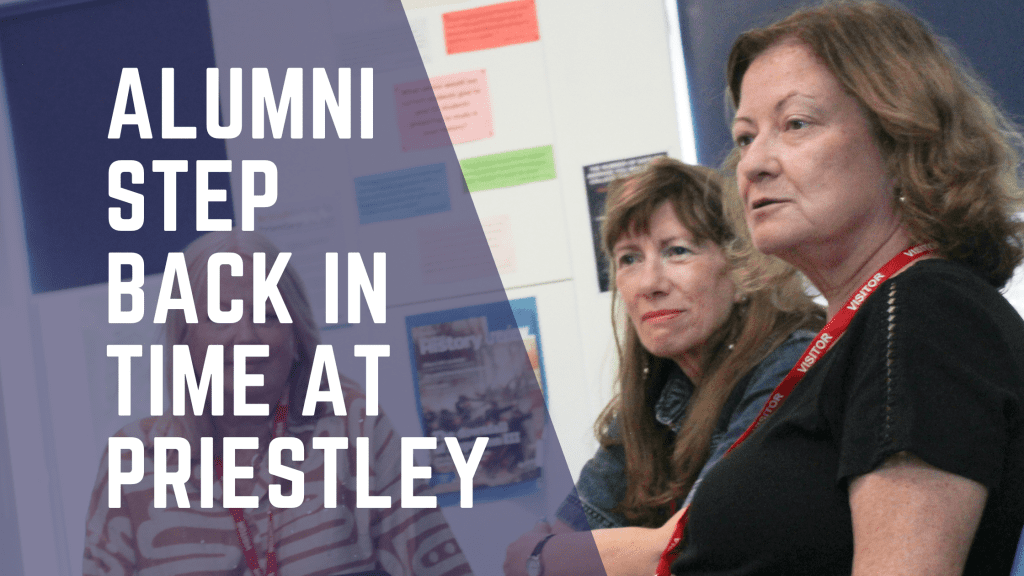
In 1977, Wendy Rydzkowski, Karen Lowe and Alison Gowdy walked out of the doors of Warrington High School for Girls, A-Level results in hand and futures uncertain. Nearly fifty years later, they returned to its successor, Priestley College, just to see how much has changed. In a candid and emotional visit, the three old friends retraced their steps through a school that once felt “unfriendly”, strict, and cold, but which they now describe with words they would never have used back then: “bright”, “inspiring”, and “colourful.”
When asking their opinions on the new building and carefully curated college atmosphere, Karen remarked almost immediately: “It’s a lot nicer. They’ve made it less…” Alison chimed in with a laugh, “Prison-like.” Karen agreed: “I was gonna say utilitarian, but yes.”
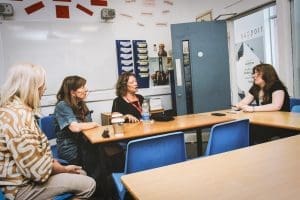
Trailing after the three on the tour, it became quite apparent how enthusiastic they were in the sheer amount of recollected memories. One would think some of their stories were made up. A portrait painted solely by deeply traditional, highly regimented, and unyielding assumption of what young women were expected to be in the 70s. “It was quite harsh, I’d say,” Wendy reflected. “Very strict on uniform. We used to have uniform checks, including underwear.”
Everyone in the interview room looked somewhat startled, myself included. Having someone check your underwear? Just to sit down and learn your times tables and what the difference between a noun and a verb is? Seems a bit too far. Though, it wasn’t the furthest extent their teachers had seemingly gone to, as Wendy continued, “I had a coat with embroidery on and they made me unpick all the embroidery.”
”Do you remember when we had to embroider our initials on every sock we owned? Our skirts, and shorts, and shirts.” Alison laughed.
The strictness wasn’t limited to attire. “When we went here, it was dark,” said Karen. “Not just in the colours, but kind of in the feel, too. The teachers were not friendly. The halls were not friendly. We had to walk on the right, stand when teachers entered, speak only when spoken to. It didn’t feel like a college, it felt more like a… military school.”
“It was always kind of negative rather than building you up.”
Wendy nodded. “I put in my diary it was an exam factory.”
It became clear through our chat that the school was mainly built to produce academic results in young girls, not necessarily rounded individuals. “Our options were very limited,” Wendy said. “Very traditional. You could do Maths, Physics, Further Maths, History, Geography, Religion, English, French, German or Spanish.”
“They did sewing and cooking, and typing – but they didn’t want you to be a secretary. That’s kind of what I got the impression of,” she added. “You can go into typing, or you can go into nursing … I mean, there was no sight of a woman in a pair of trousers, was there?”
In this, there has been an astronomical change within the available subjects and expectations (especially of young women and girls) in high schools and colleges alike. At Priestley College, some of these include Performance and Production Arts, Criminology, Journalism, Geology, and so many more. It really puts into perspective how lucky we are today career-wise and, more simplistically, option-wise. Just imagine having to attend a school based strictly on gender, not on your talents or abilities, and – as a girl, at least – being told to simply “be a nurse in Edinburgh”, because that’s all that was expected of you.
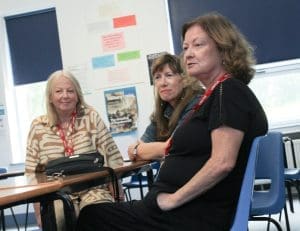
That’s one thing I admire about Priestley, actually. Their drive and encouragement for you to take all that you can out of their courses and your time at Priestley. Enrichments, events, extra opportunities for UCAS points, subject trips, job opportunities, guides on how to write your personal statement so you have a better chance of getting into your dream university. It’s all a luxury compared to what Wendy, Karen, and Alison had to endure.
Despite Warrington High School for Girls being rather “harsh”, it seemed to be the right path to go down at the time – especially for Karen. “We had to pass a test to get into this school, which is very elitist. I passed. My sisters did not. I got the opportunity to come to this school, and I hated it in many ways, because it was a tough school. It wasn’t very nurturing. However, I think it gave me a boost out of my neighbourhood, my background. It gave me a chance to achieve more, it gave me a bit of a vision.”
“I could see I was around people who were educated, and then I went to the US when I was 18, and I did brilliantly in university in America because of my study habits from high school, because of my A Levels,” she added.
She later mentioned a “field trip to Oxford”, and how it immediately deterred her from applying; “It was the 70s and all the girls were wearing long, flowery dresses and I was poor from the Northwest. When I spoke they looked at me like I had two heads, and I immediately thought, “I am never coming to this place.”
Another thing to admire about modern day sixth form. I love that I have people that achieved completely different grades in each of my classes. Some people might’ve gotten a grade 9, some people might’ve gotten a grade 4, and yet we’re all in the same class. We’re all learning the same material, listening to the same teacher, trying to achieve and grow. There aren’t sets like there are in high school, and it seems a lot more humanising. You’re not evaluated by your capabilities, you’re evaluated by your passion and interests – like a real human being.
“We were being prepared, mostly to go to university, I think. And to be girls,” Wendy mentioned.
“My career advisor said, “what do you like?” And I said, “German, Biology and Art.” And she said “well be a nurse in Edinburgh, then.”
We spoke a lot of how things have changed since 1977, most of the topics discussing how students now have a lot more to rely on and a lot more knowledge to base decisions off, whether this be family members, advice from organisations or universities themselves, careers advisors and websites online, or even teachers.
Not to mention, there are so many more options with apprenticeships, a wide range of universities and the subjects they offer, vocational courses, graduate jobs, etc.
“I was just in the library one day, looking at the career stuff thinking, “what am I gonna do?” No direction, nothing. My parents didn’t know anything, and I remember thinking, “maybe I could go into the Army.” And my English teacher, who never spoke to me outside of class – before or after – said to me, “Karen, are you thinking of going to university?” And I said, “I don’t know.” So she said, “wait a minute,” and she went into the staff room. She must’ve talked to my teachers and she came out, and she said, “your teachers say you should go.” And I was like, “oh, maybe I will.”
“But that was our counselling. That was it,” Karen continued. “And if she hadn’t done that, I probably wouldn’t have gone because nobody in my family had ever gone to uni. I didn’t know what I was meant to do. None of us knew, did we? It was very difficult.”
Wendy decided to leave home, though not like Karen who emigrated to the U.S. after graduating. “I chose the furthest from my home. It was Canterbury.”
For Alison, it was completely the other direction. Literally. “I chose my university because I like swimming, and it had the biggest swimming pool in the world. Also, it was fairly close to where my boyfriend at the time was at university.”
As a teenager, you don’t think much about the big things. Interviews, preparation, studying, deciding your future at the somewhat immature age of 18. It all seems daunting, how fast things move after high school. It seems like Karen felt this, too.
“I interviewed at Newcastle University. Don’t ask me why I put them down, I think it was because my uncle lived there. I put them down and it was the only one I actually went to an interview for. And I sat down in the interview and the lady said, “why did you pick Newcastle?” And I said, “I don’t know.”
Like Karen, Wendy mentioned that she felt unprepared. “I decided to apply to Oxford and Cambridge. Of course, you’re up against people from Manchester Grammar and Manchester High, where they were tutored.”
In case it’s unknown, it’s necessary to take entry exams for highly competitive and desired programs, such as the specific fields of medicine, law, maths, and engineering. Yet another daunting expectation.
“I was sitting upstairs on my own and opened the paper, and it was a Philosophy paper. Philosophy had nothing to do with what I wanted to study, and it said ‘examine the logic of this argument’. There was no preparation, not for Oxford and Cambridge.”
On the topic of universities, I concluded the interview by asking for any advice the three had for students looking into and aspiring to go to university.
“Follow your passion.” Karen was quick with her answer. “Sometimes your passion takes you where you don’t expect, so be open to new things. And it’s not the end of the world if you change your mind, you know, it’s not too late to change. But go for your passion, I’d say.”
Wendy had a more critical approach. “I would say get information about what course you want to do, because we didn’t really have that. What course you want to do, as well as why you want to be doing it, and what’s the best place for that course. Don’t worry about the accommodation. That’s what I see too much, you know, go and have a look at the program.”
“Also, pupils don’t read as much,” she continued. “They used to read lots of books and newspapers and things, and they tend to get smaller chunks of things now, don’t they? Not a huge thing. So, I say just read as much as you can.”
“You have to look at the ratings, too. It’s a bit of trickery, so my son would say. Everyone wants their university to be good, and if no one wants to stay, they’ll lie about the ratings, won’t they? And you go, “oh, student satisfaction rating of 90%,” and you go read the reviews and it doesn’t match up.”
Within their own experiences, Wendy felt like she went for a “joke,” at first. “I thought, “oh, I’ll just go and get out of school and go on a day out,” and it was a bit of a joke. And then I thought, “you know what, this place is me down to the grounds. I like this place best.”
“I think what mistake I made is that I only focused on the years at university, the course. I had no plan beyond that,” Alison chimed in.
“I sort of got towards the end of the third year and had to start again thinking, ‘what now?’ I did a teaching course for another year, but it was mainly just to stay in the end.”
All in all, it’s clear that there’s been an astounding change and development in the last 50 years, especially in the eyes of Karen, Wendy and Alison.
From student expectations and treatment, to preparation and assistance in future endeavours. In the “inspiring” and “bright” environment curated at Priestley College, it’s no doubt that all past, current, and future students have, are, and will benefit from the encouragement, the positive difference that each teacher and staff member makes, and the sheer pragmatism and promise that radiates from every classroom. Especially since there are no more underwear checks.