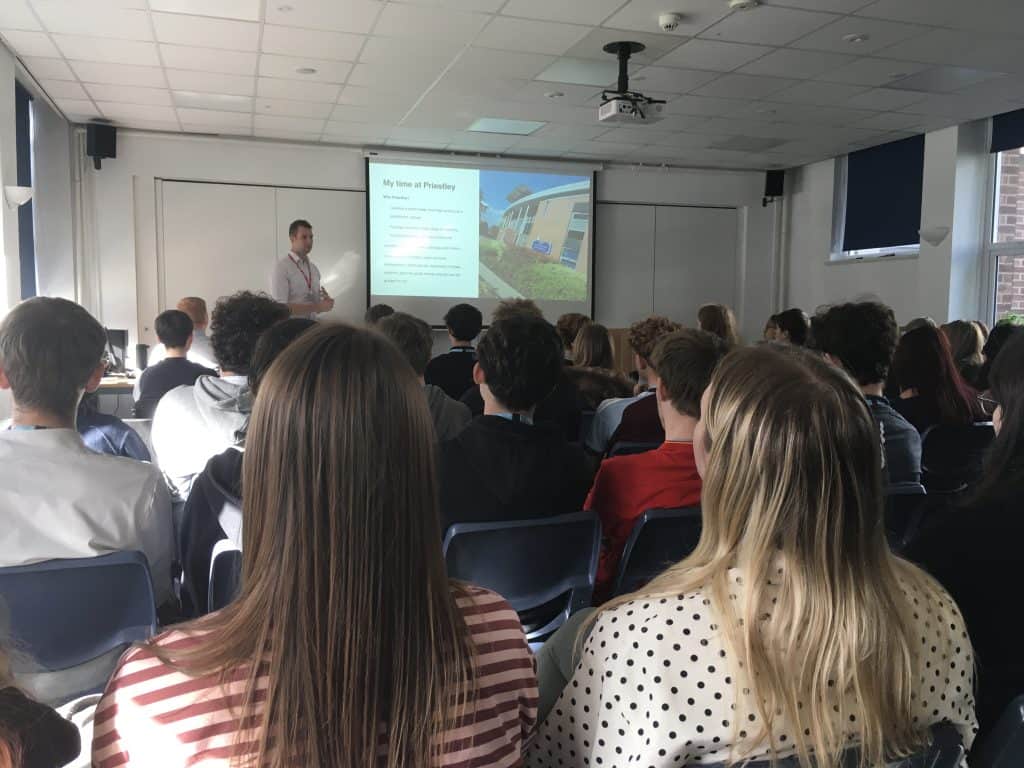
A former Priestley student returned to college on Friday to share his career journey and inspire students with the opportunities available in the rail industry.
Matthew Allen left Priestley with outstanding A-Level results, achieving A*s in French and Chemistry and As in Maths and Geology. He went on to study BSc Geology at Imperial College London before completing a master’s degree in Transport, which helped him find his way into the rail industry.
He is now Demand & Revenue Forecasting Lead at West Coast Partnership Development (WCPD), a sister company to Avanti West Coast, where he leads forecasting and modelling work to help understand passenger demand and plan future rail services.

“Studying at Priestley not only gave me the grades I needed but also the friendships and independence I was looking for,” he said.
“I think it was closer to the university experience than I would have had at my sixth form.”
Matthew explained that, although he enjoyed his subjects and knew he wanted to continue studying, he did not have a clear idea of the career he wanted to pursue.
His interest in geology led him to university, where he developed analytical and problem-solving skills that would later prove valuable in transport.
A postgraduate degree helped him connect those abilities with his interest in the railway network, ultimately opening the door to his current career.
Today, his work involves using data and modelling to predict how many people will travel by rail, where they will travel from and to, and how passenger behaviour might change when services are altered or expanded.
During his visit, Matthew encouraged students to look beyond the most obvious career paths and recognise the wide range of opportunities available within the rail industry.
He also highlighted the importance of transferable skills, explaining that while he does not necessarily use the specific content of his A-Levels in his day-to-day work, the analytical thinking, data analysis, problem-solving and communication skills he developed remain valuable.
“One thing I want to get across to the students is that the industry needs more than engineers, it needs everything from project managers to HR experts and medical staff,” he said.
“In this industry you can do everything from managing people to managing infrastructures.”